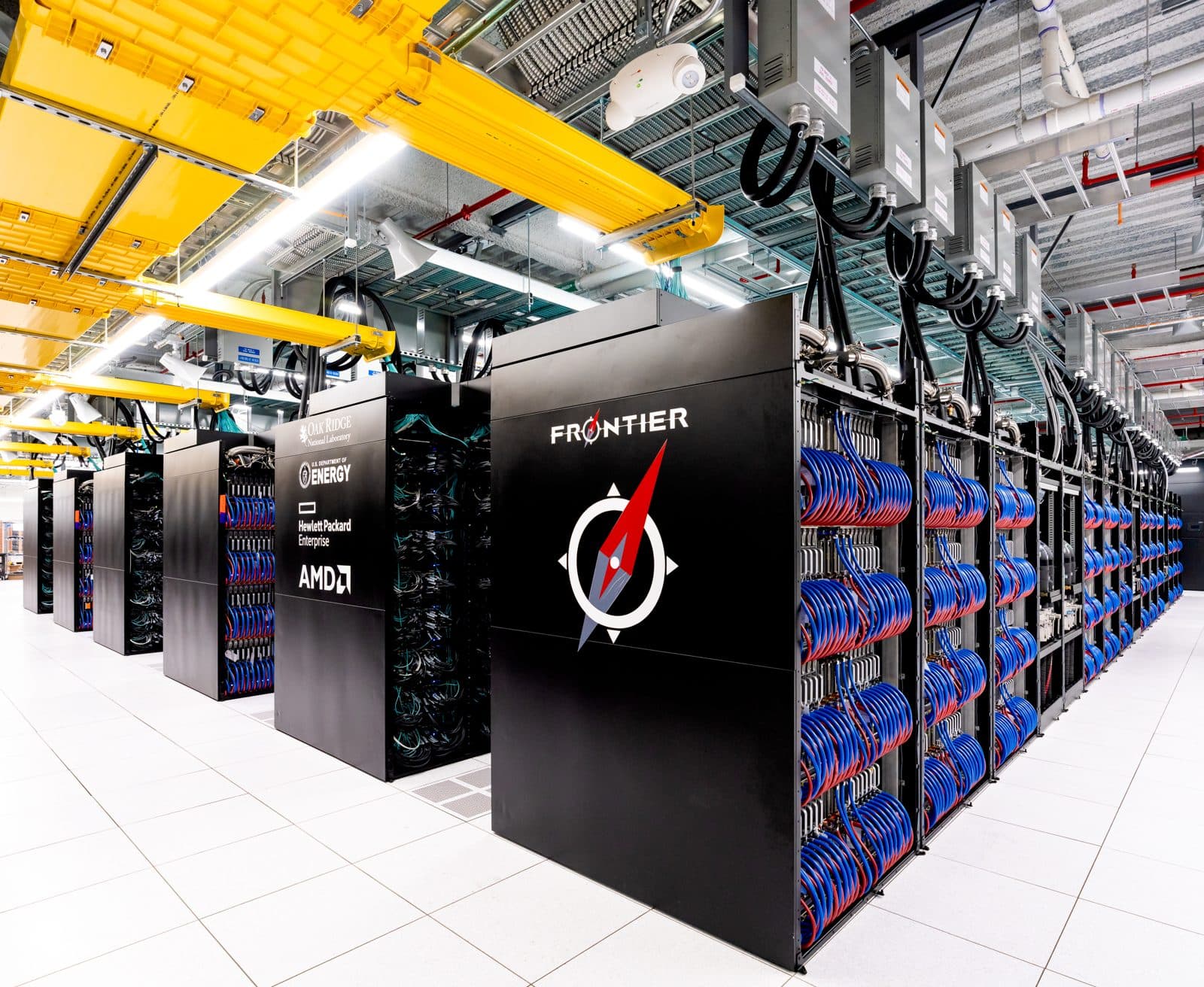
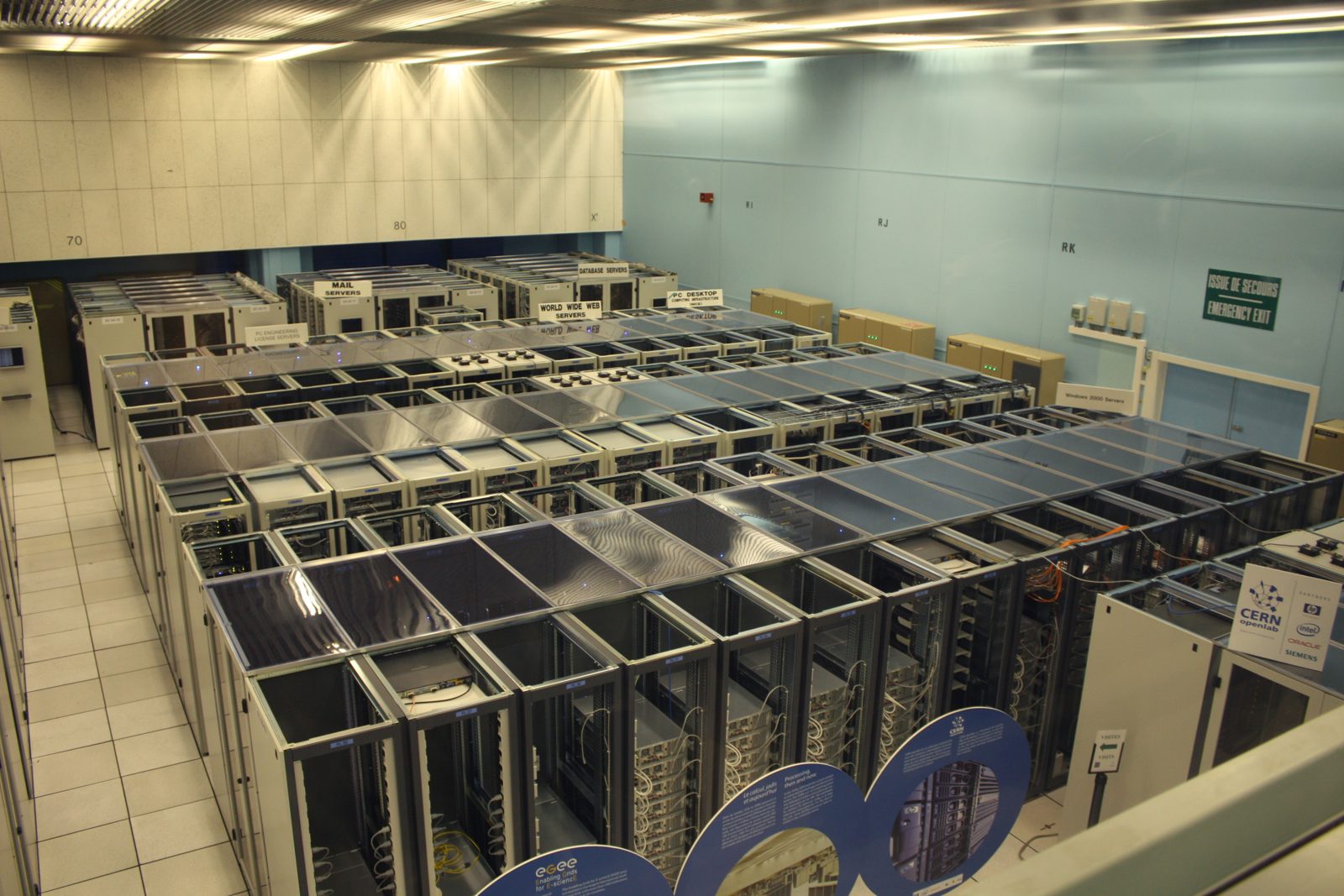
For forty years the data centre has been an air-conditioned room. Chillers make cold water, computer-room air handlers blow cold air under a raised floor, servers suck it through and blow it out hot, and the whole cycle repeats. It worked because a rack rarely drew more than 5 to 10 kW.
That assumption has broken. A single NVIDIA GB200 NVL72 rack draws around 120 to 130 kW and ships liquid-cooled only. NVIDIA has already laid out a path to 600 kW racks by 2027. Air simply cannot carry that much heat out of a 600 mm wide cabinet, however hard the fans spin.
This post explains how traditional air cooling works, how the two main liquid approaches differ, what they save, who makes the equipment, and what it means if you are planning a data centre in Bangladesh.
How traditional air cooling works

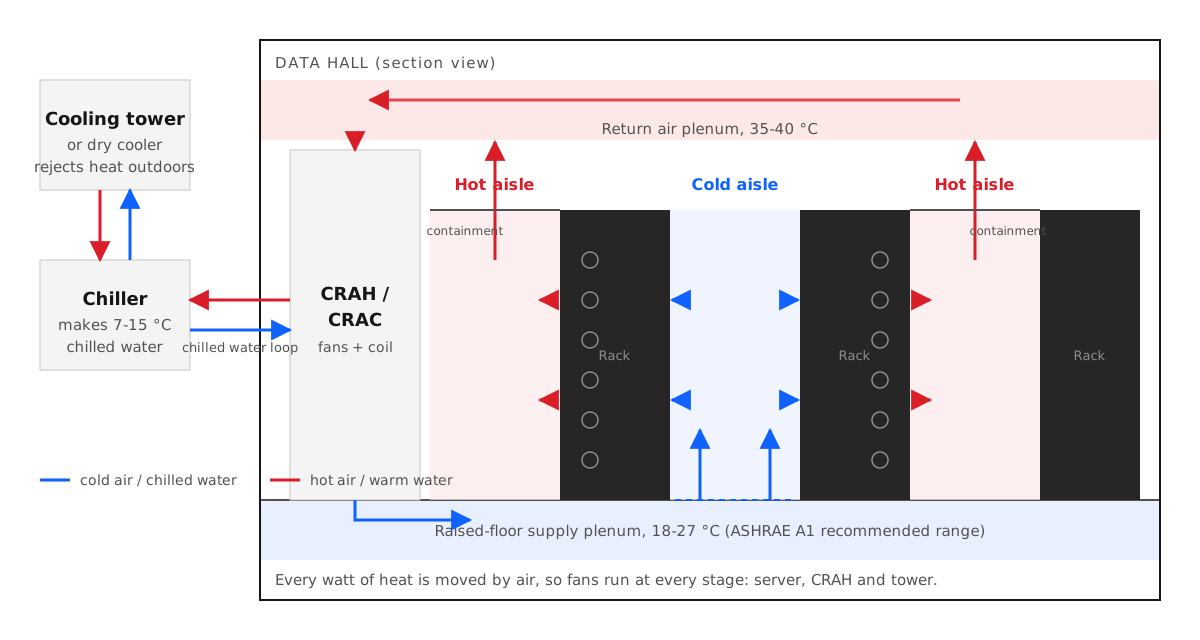
The chain has five links, and every one of them moves heat with air or needs a compressor:
- Chiller. A refrigeration plant cools water to roughly 7 to 15 °C. It is the single largest energy consumer after the servers.
- CRAH or CRAC units. Fan-and-coil units at the edge of the hall use that water to cool room air to the ASHRAE A1 recommended range of 18 to 27 °C.
- Raised floor and cold aisle. Cold air is pushed under the floor and up through perforated tiles in front of the racks.
- Server fans. Each server pulls air across its heat sinks. In an air-cooled GPU server, the fans alone can consume 10 to 20 percent of the server's power.
- Hot aisle and return. Exhaust air at 35 to 40 °C is contained, returned to the CRAH units, and the loop starts again.
Air has two physical problems. It carries very little heat per litre, about 3,500 times less than water by volume, so you need enormous airflow as the load grows. And it must be made cold to work at all, which means running chillers for most of the year in a climate like ours.
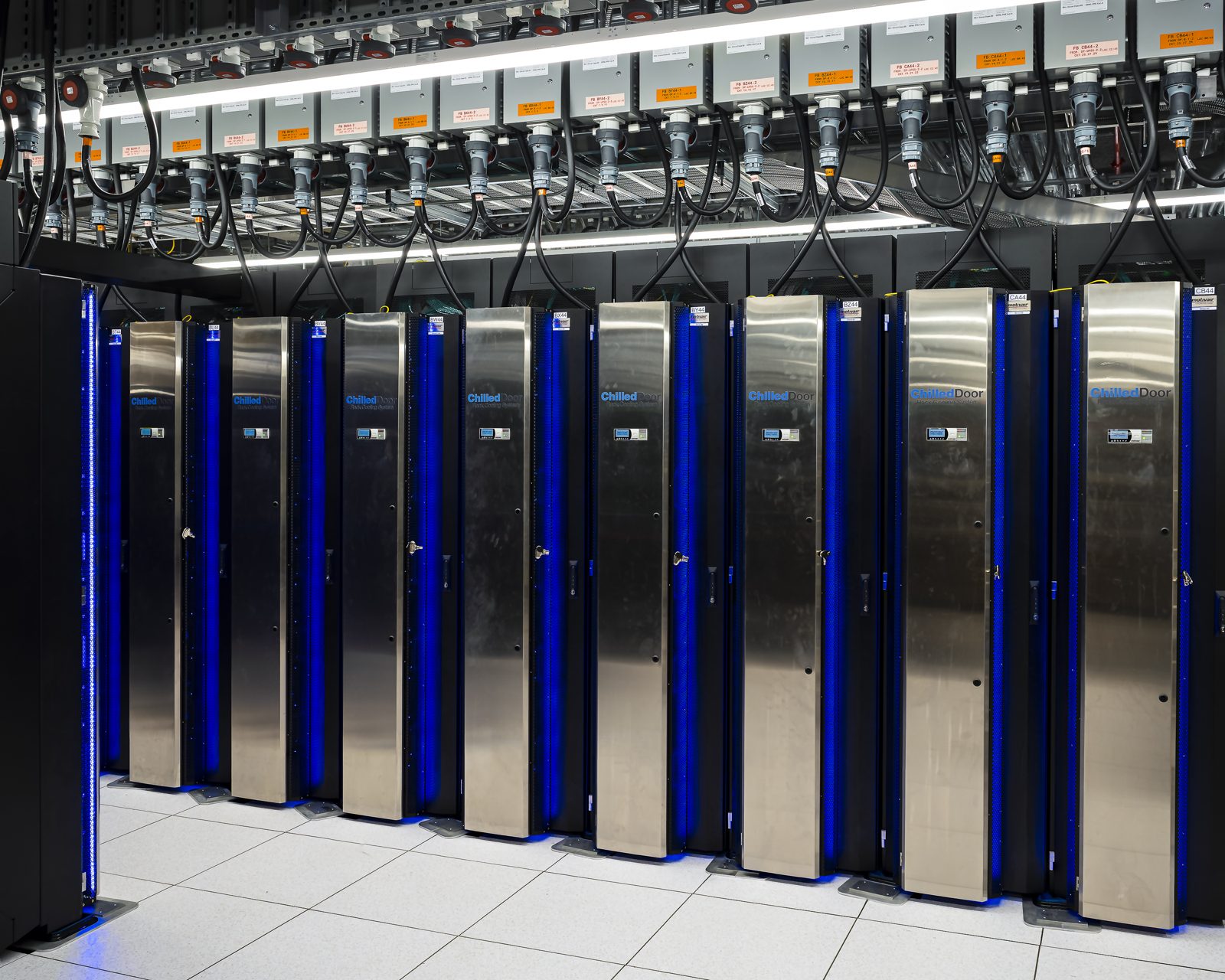
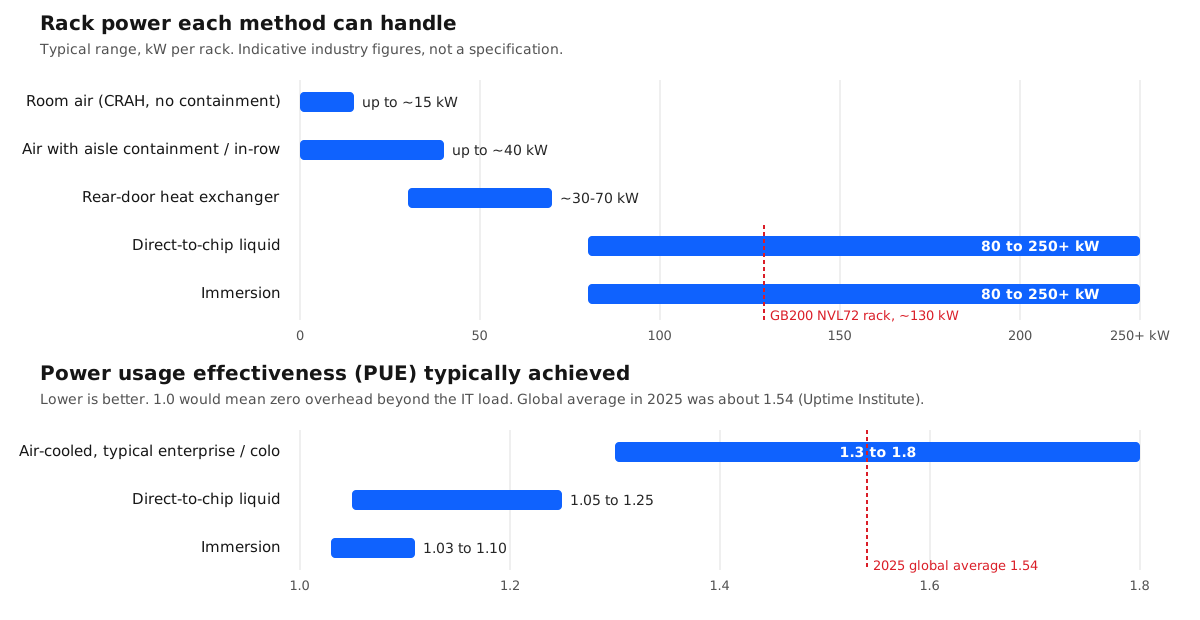
Good containment and in-row cooling stretch air to around 30 to 40 kW per rack. Rear-door heat exchangers, which bolt a water coil onto the back of the rack, reach 50 to 70 kW. Beyond that, the only answer is to bring the liquid to the chip.
Direct-to-chip liquid cooling
Direct-to-chip, also called direct liquid cooling or cold-plate cooling, replaces the heat sink on each GPU and CPU with a sealed copper plate that has water flowing through it. The server keeps its shape and still slots into a standard rack, but a pair of hoses now runs to a manifold at the back.
.jpg)
The key piece of plant is the coolant distribution unit (CDU). It holds a plate heat exchanger that keeps the clean, treated loop inside the servers separate from the facility water, plus pumps, filters, controls and leak detection. CDUs come as rack-mounted units of a few hundred kilowatts, or row and facility units rated from one to several megawatts.
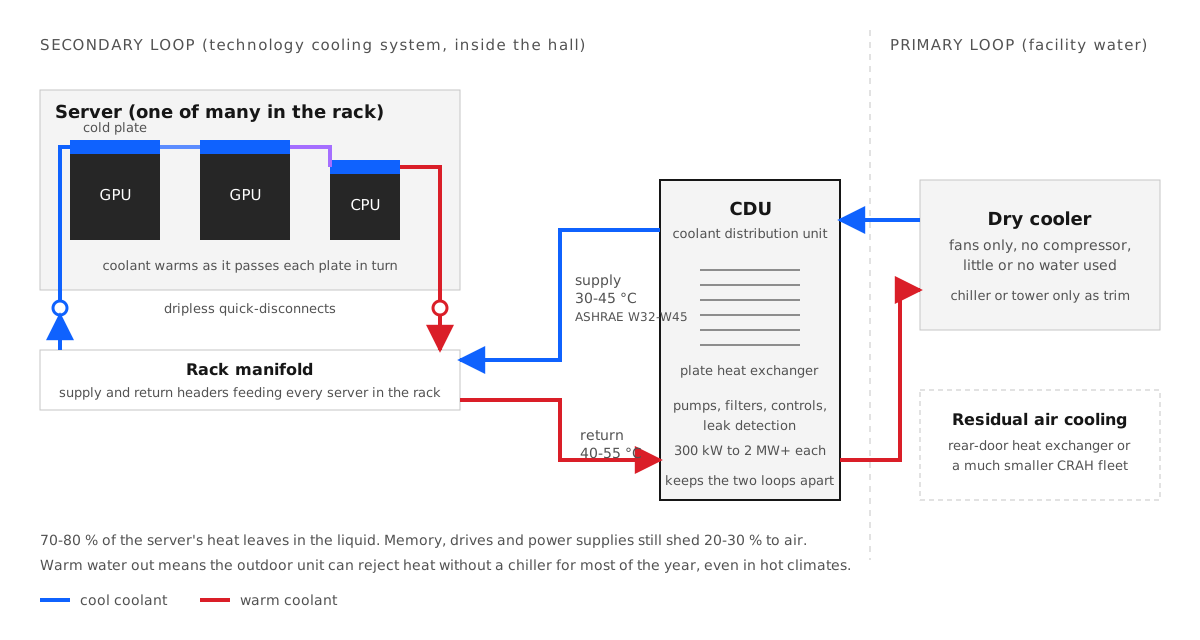
The number that changes everything is the water temperature. Because the plate sits directly on the chip, the coolant can enter at 30 to 45 °C and still keep a GPU within spec. ASHRAE defines these as the W32 to W45 classes. Water that warm can be cooled by an outdoor dry cooler, a fan-and-radiator unit with no compressor, for most of the year even in a hot climate. The chiller becomes a trim device rather than the main plant.
What it does not do is remove every watt. Memory, drives, network cards and power supplies still shed 20 to 30 percent of the heat into air, so a direct-to-chip hall keeps a smaller air system or rear-door heat exchangers for the remainder.
Modern direct-to-chip in practice: the GB200 NVL72
_20.png)
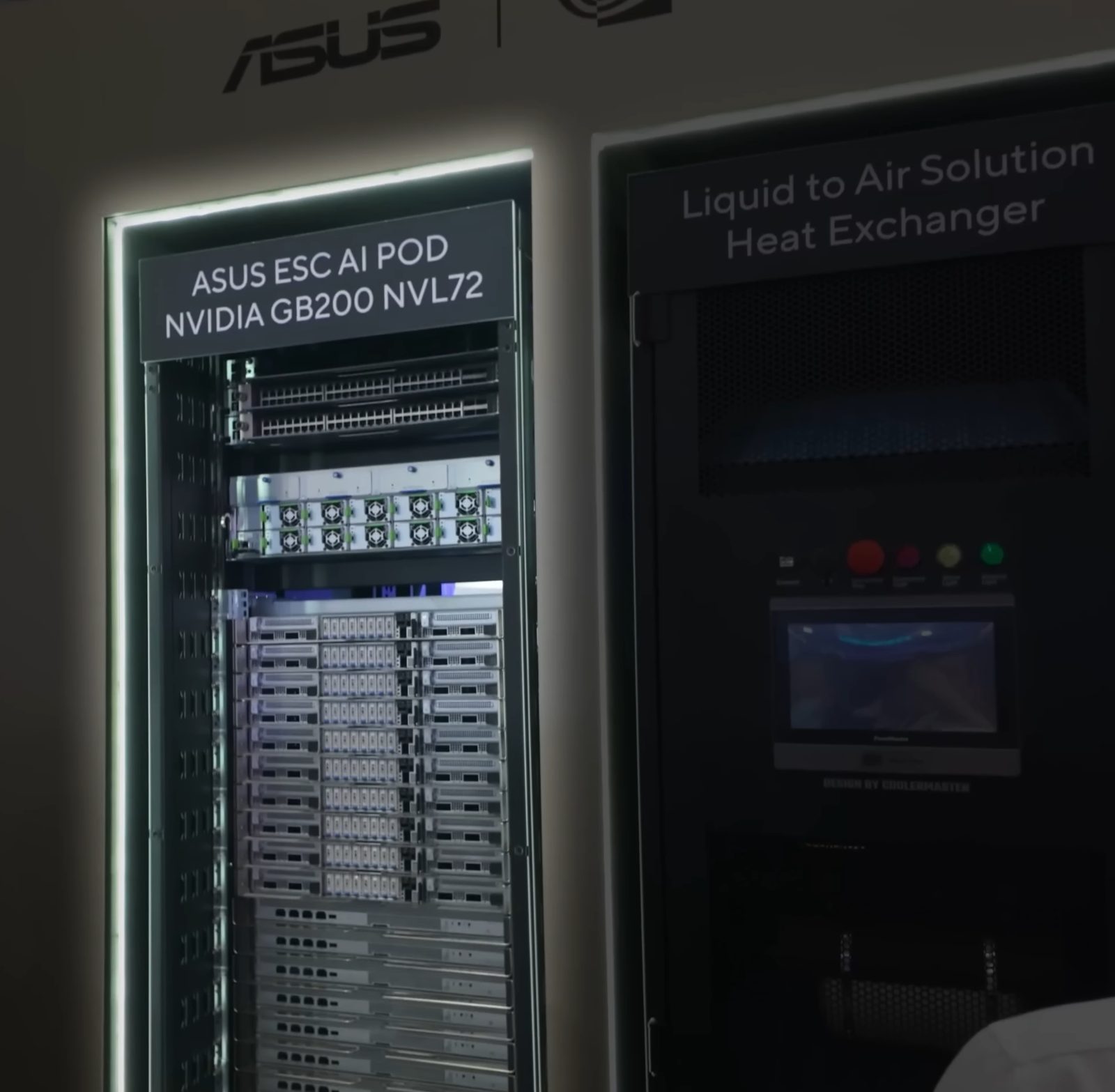
NVIDIA's rack-scale systems show where the whole industry is heading. A GB200 NVL72 packs 72 Blackwell GPUs and 36 Grace CPUs into one cabinet with cold plates on every chip, blind-mate coolant connectors on every tray, and a rack manifold fed by an in-row or in-rack CDU. The successor Vera Rubin NVL144 platform expected in 2026 is estimated at roughly 200 kW per rack, and the Kyber rack planned for 2027 targets 600 kW. None of these can be air-cooled.
For sites that lack facility water, OEMs offer a liquid-to-air sidecar, a cabinet-sized heat exchanger that takes the rack's warm coolant and dumps the heat into the room's air. It lets an existing air-cooled hall host a few AI racks, but it only moves the problem: the room still has to carry all that heat as air.
Immersion cooling
Immersion takes the opposite view: instead of plumbing each chip, submerge the whole server in a tank of dielectric fluid, a synthetic oil that does not conduct electricity.
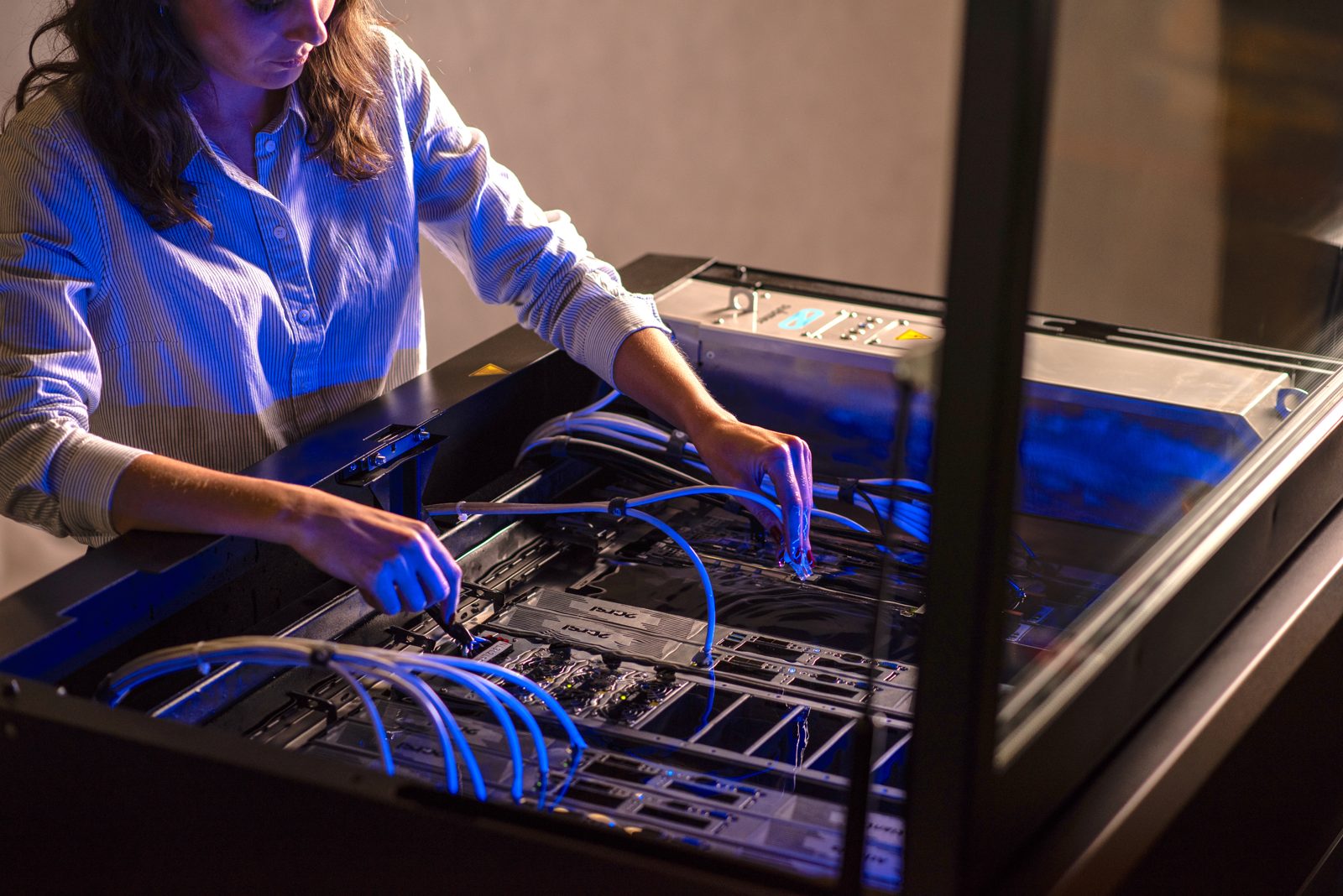

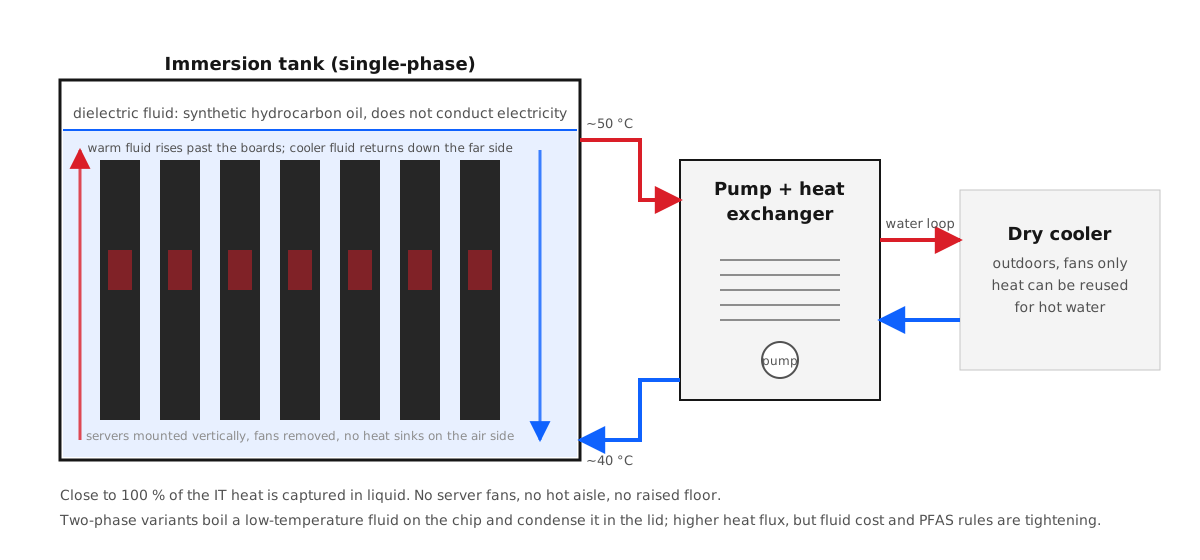
In single-phase immersion the fluid stays liquid, warms as it passes the boards, and is pumped through a heat exchanger. In two-phase immersion a low-boiling-point fluid boils on the chip surface and condenses on a coil in the tank lid. Two-phase handles higher heat flux, but the fluids are expensive and the fluorinated chemistries face tightening PFAS regulation, so the market has moved firmly towards single-phase.
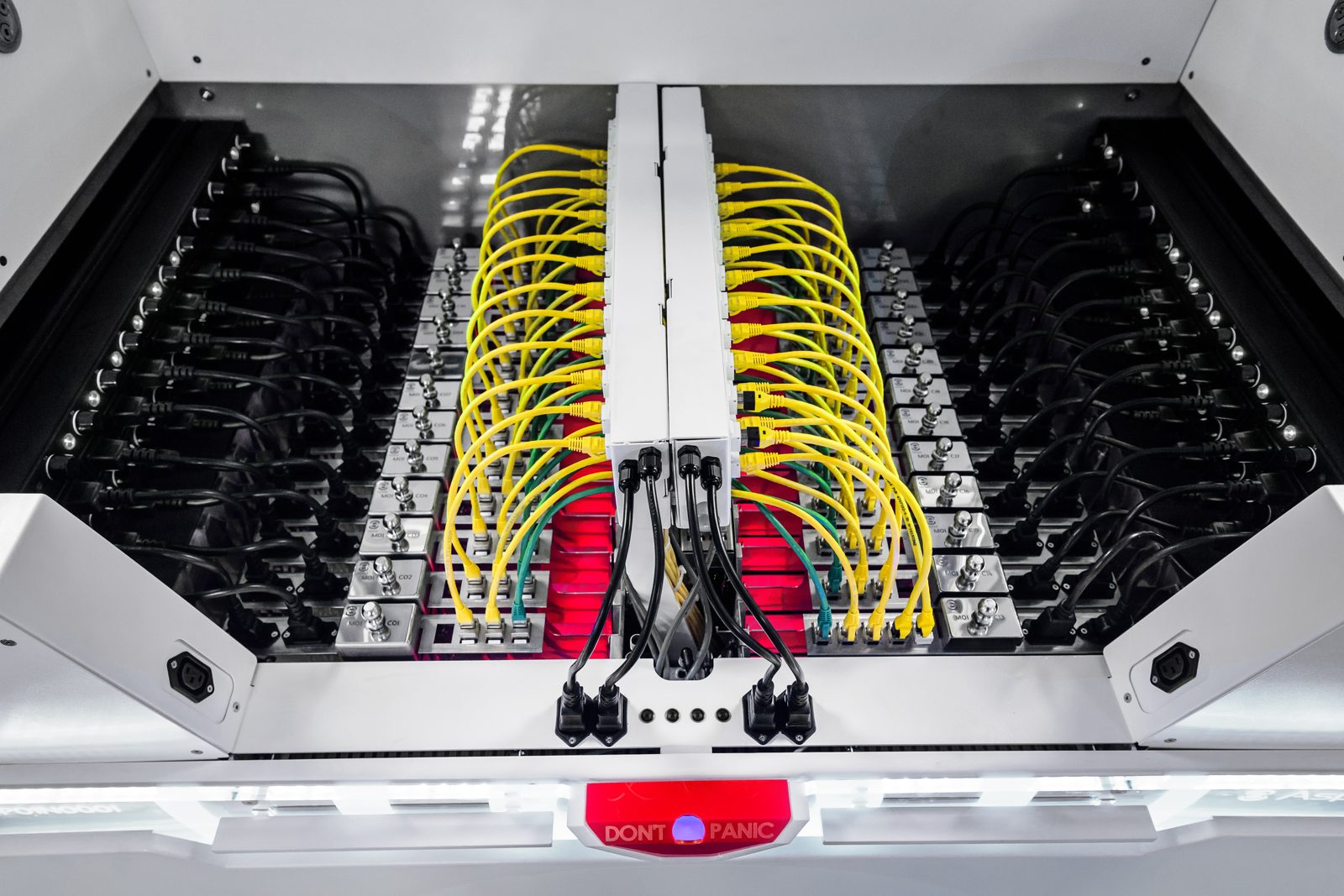

Immersion captures close to 100 percent of the heat in liquid, removes every server fan, and needs no raised floor, hot aisle or room air conditioning. The trade-offs are real: servers must be fan-less and immersion-qualified, warranties need to be confirmed with the server OEM, tanks need floor space and floor loading checks, and technicians work with wet hardware. It suits greenfield builds, edge sites and crypto or HPC workloads more than a retrofit of an existing enterprise hall.
What the numbers say
| Air cooling | Direct-to-chip | Immersion | |
|---|---|---|---|
| Practical rack density | 10 to 40 kW | 80 to 250+ kW | 80 to 250+ kW |
| Heat captured in liquid | 0 % (rear-door HX up to ~80 %) | 70 to 80 % | ~100 % |
| Coolant or supply temperature | 18 to 27 °C air | 30 to 45 °C water | 40 to 50 °C fluid |
| Chiller required | Yes, most of the year | Trim only, or none | Trim only, or none |
| Typical PUE | 1.3 to 1.8 | 1.05 to 1.25 | 1.03 to 1.10 |
| Server fan power | 10 to 20 % of IT load | Reduced by roughly half | Zero |
| Water consumption | High with evaporative towers | Low with dry coolers | Low with dry coolers |
| Noise | 80 to 90 dB in the hall | Much lower | Near silent |
| Retrofit into an existing hall | Native | Rack by rack, with CDU | Difficult |
| Hardware choice | Any | Growing fast, standard for AI | Immersion-qualified only |
Three results matter most.
Energy. The Uptime Institute's 2025 global survey put average PUE at 1.54, a figure that has barely moved in six years because air cooling has run out of easy gains. Direct-to-chip sites routinely report 1.1 to 1.2, and immersion sites close to 1.05. On a 10 MW IT load the difference between 1.54 and 1.15 is nearly 4 MW of continuous cooling power, which at Bangladeshi industrial tariffs is a seven-figure dollar saving every year.
Water. Many large air-cooled facilities reject heat through evaporative cooling towers, which consume millions of litres of water a year. Warm-water liquid cooling with dry coolers uses little or none. That matters anywhere groundwater is stressed.
Heat reuse. Water at 45 to 55 °C is useful. The SuperMUC systems at the Leibniz Supercomputing Centre in Munich have run on warm water since 2012 and use the waste heat to warm the building. District heating, absorption chillers and process hot water are all practical once the heat leaves as warm liquid rather than lukewarm air.

Where air cooling still makes sense
Liquid is not the answer to everything. Air cooling remains the right choice when:
- Rack density stays below about 20 kW, which is still true of most enterprise, storage and network racks.
- The hardware mix is varied and changes often, so standardising on cold plates is impractical.
- The facility is leased colocation space where you do not control the plant.
- The team has no experience with water near servers and no budget for leak-detection and commissioning.
Most new builds end up hybrid: a liquid-cooled zone for AI and HPC racks, served by CDUs and dry coolers, alongside a conventional air-cooled zone for everything else. The ASHRAE guidance is to plan for direct liquid cooling once a rack passes roughly 20 kW, and the cost crossover point in most analyses sits around 40 to 50 kW per rack.
The OEM landscape
The supply chain has matured quickly, driven by hyperscale AI builds. The main categories and vendors are:
Server and rack OEMs with liquid-cooled products
- NVIDIA sets the reference designs: GB200 and GB300 NVL72 today, Vera Rubin and Kyber next.
- Dell Technologies ships the IR7000 rack and PowerEdge XE9712 for NVL72, with its own CDUs.
- HPE offers fan-less direct liquid cooling across HPE Cray EX, the platform behind Frontier and El Capitan, and ProLiant Compute servers.
- Lenovo has shipped warm-water Neptune cooling for over a decade, from SuperMUC to current ThinkSystem SC and SR servers.
- Supermicro sells complete DLC racks with in-rack CDUs and claims the largest shipped volume of liquid-cooled AI racks.
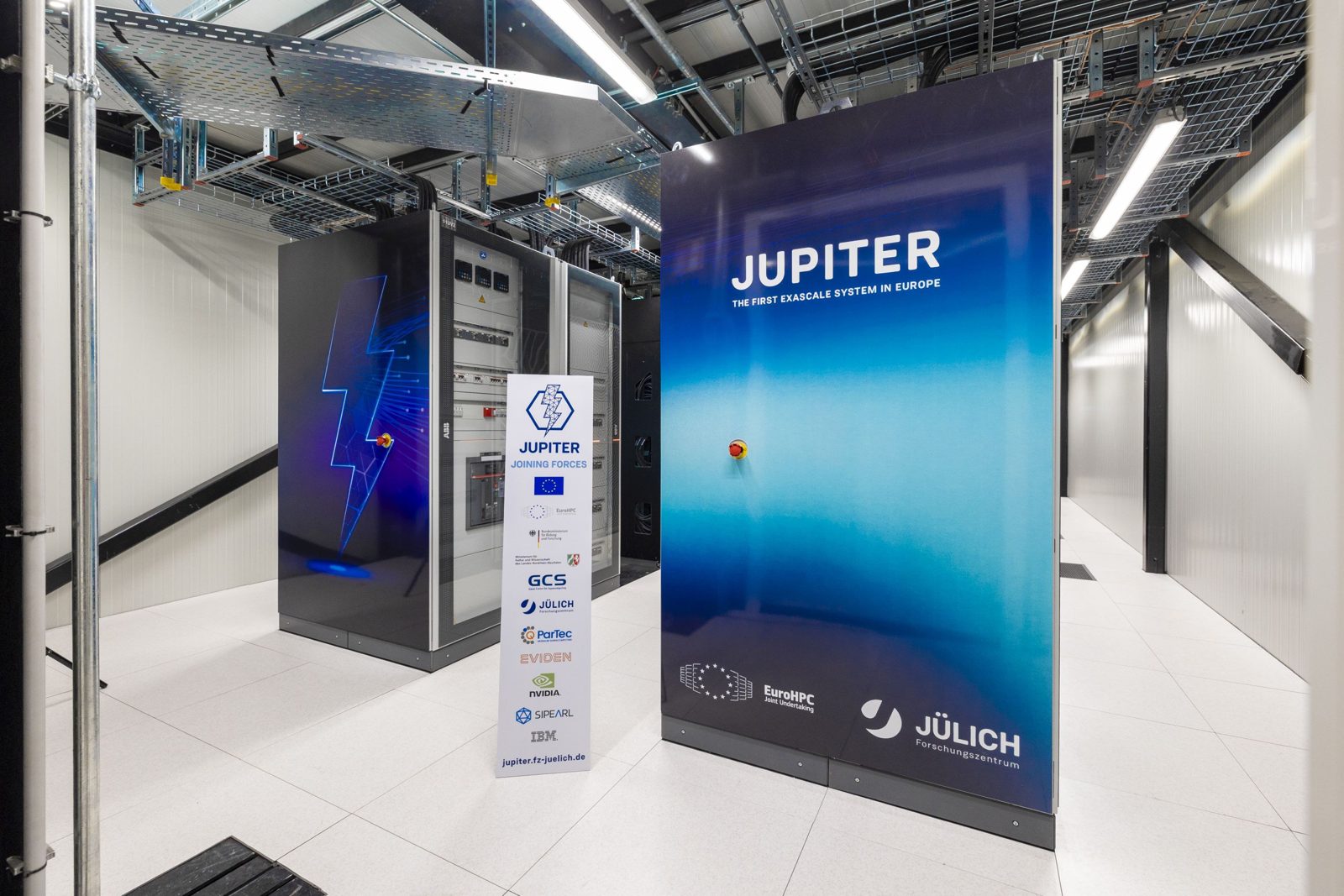
- Eviden (Atos) builds the BullSequana XH3000 behind JUPITER, Europe's first exascale system.
- ASUS, Gigabyte, Foxconn, Quanta and Wiwynn supply NVL72-class racks to cloud providers and enterprises.
- AMD ships the MI355X as a liquid-cooled part and its 2026 Helios rack, a double-wide 72-GPU system built with HPE and Meta, is liquid-cooled throughout.

Cold plates, manifolds and CDUs
- Vertiv (CoolChip CDUs, rear-door exchangers and full liquid-cooling reference designs with NVIDIA).
- Schneider Electric, which acquired cold-plate and CDU specialist Motivair to complete its liquid portfolio.
- CoolIT Systems, the largest independent cold-plate and CDU maker, found inside many Dell, HPE and Supermicro systems.
- Boyd, nVent, Asetek, JetCool (Flex), ZutaCore and Accelsius for cold plates and rack-level CDUs, including two-phase direct-to-chip from the last two.
- Stulz, Rittal, Delta, Trane and Johnson Controls for row and facility CDUs and the outdoor heat-rejection plant.
Immersion systems and fluids
- Submer, GRC (Green Revolution Cooling), LiquidStack, Iceotope and Asperitas for tanks and pods.
- Shell, Castrol, ExxonMobil, Chemours and Engineered Fluids for dielectric fluids.
Standards worth asking every vendor about
- ASHRAE TC 9.9 liquid cooling classes (W17 to W45 and W+), which define the facility water temperature a system accepts.
- Open Compute Project (OCP) ORV3 rack, blind-mate manifold and CDU specifications, which are becoming the common interface across vendors.
- Coolant chemistry: most direct-to-chip loops use propylene glycol and water with inhibitors, and mixing fluids across vendors voids warranties.
What this means for Bangladesh
Dhaka's climate is hot and humid year round, grid power is constrained, and water is not free. All three push towards warm-water liquid cooling for any new AI or HPC capacity:
- Free cooling becomes possible. A chiller-based air system never gets free cooling here. A W40 or W45 direct-to-chip loop with dry coolers can run compressor-free for most of the year, with adiabatic assist or a trim chiller for the hottest afternoons.
- Every megawatt counts. Where a grid connection or captive gas generation is the binding constraint, a PUE of 1.15 instead of 1.5 means roughly 25 percent more servers for the same power.
- Hardware is already liquid. Any GPU cluster bought from this point on will arrive liquid-cooled. Designing the hall for air today means a second project in two years.
- Skills, not just kit. The hard part is commissioning: water quality, pressure testing, leak detection, flow balancing and the interface between the IT and facilities teams. That is where an integrator earns its keep.
CompTech designs and delivers data centre infrastructure for government and enterprise in Bangladesh, and we work with the server, cooling and power OEMs listed above. If you are planning AI capacity, or want to know whether your existing hall can take a liquid-cooled zone, talk to us.
Photo credits: Frontier cover and cabinet images by OLCF at ORNL and Oak Ridge National Laboratory, CC BY 2.0. Other photographs are credited in their captions and used under their Creative Commons licences from Wikimedia Commons. Diagrams by CompTech.
.jpg)